Empowering the Next Generation to Lead with Purpose, Passion & Integrity
A guidebook created for community educators developing Global Youth Leaders
Welcome to this guidebook created for educators who mentor, teach, coach, and otherwise guide youth in their development as upstanding citizens of their local and global communities. The Arthur Ashe Legacy Project at the University of California, Los Angeles (UCLA) launched the Global Youth Leadership Academy in 2025 with a mission to empower the next generation of global leaders to challenge systemic inequities and create the conditions that allow all nations and people to thrive and achieve their desired outcomes.
Rooted in the legacy of U.S. tennis figure and activist Arthur Ashe, this guidebook reflects compelling themes from his life on and off the court. These themes are aligned with the goals of this project to develop global citizenship, civic engagement, and leadership in today’s youth through international tennis and athletics communities. Each segment of this guidebook provides background information about this international tennis legend and learning activities designed to inspire young leaders and equip them with the tools and vision to shape a sustainable future that is equitable, prosperous, joyful, and peaceful for all.
The learning opportunities presented in this guidebook include reflective and collaborative activities, which may be adapted to suit the needs of the group. Learning activities are designed to foster skill development in communication, problem-solving, collaboration, and leadership. With attention to social and emotional well-being, these activities offer opportunities for youth to hone their skills of self-reflection, empathy, compassion, and teamwork while building agency for personal growth and social justice. We have used a global competence framework to align our efforts with those adopted by global educators worldwide, whose goals are aligned with this project.
The Global Youth Leadership Academy supports formal and non-formal educators working with youth through tennis and community-based organizations serving communities in the United States, the United Kingdom, France, Zambia, and South Africa.
How to Use this Guidebook
This guidebook presents 12 themes that are reflected in the life and legacy of Arthur Ashe:
Each theme includes an introduction to stimulate thinking about the theme and explain how it relates to Arthur’s personal and professional life. You are encouraged to read this introductory information to the youth if appropriate. If not appropriate for any reason, feel free to read applicable portions of the introduction or summarize the information for your group. Feel free to use the introductions as background information for yourself as you determine the best way to introduce the theme, share information about Arthur, and engage youth in the learning activities.
After the introduction under each theme, we have provided a variety of learning activities intended to help youth develop as individuals, global citizens, and leaders. You may adapt the learning activities to suit the ages, group size, and context of those with whom you are working. You will notice that each Learning and Leadership Activity is listed in one of four colors. These colors align with the four domains of global competence, and the activity is designed to help youth develop skills embedded in that domain. For example, green signifies the domain of Investigate the World. An activity presented in green supports youth in investigating the world through one of these global competence practices:
Explore the world with curiosity
Pose questions to better understand issues and perspectives
Identify and suspend assumptions and judgments
Recognize the value of each person in a global community
For more information about global competence domains and practices, see the section below.
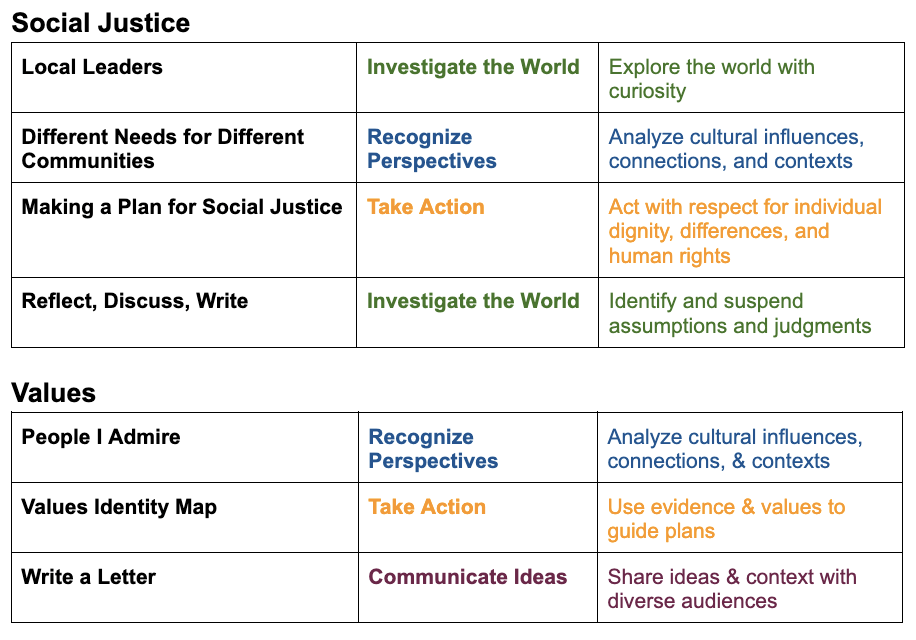
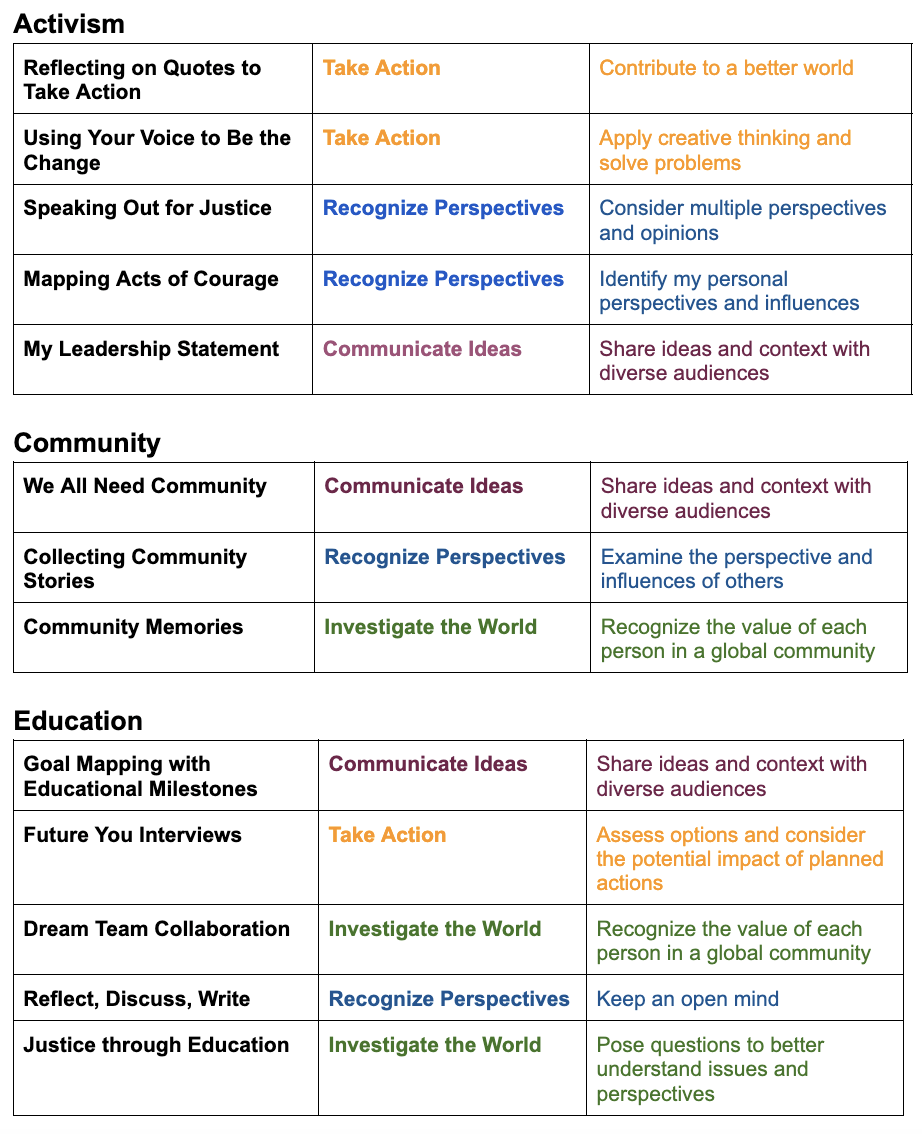
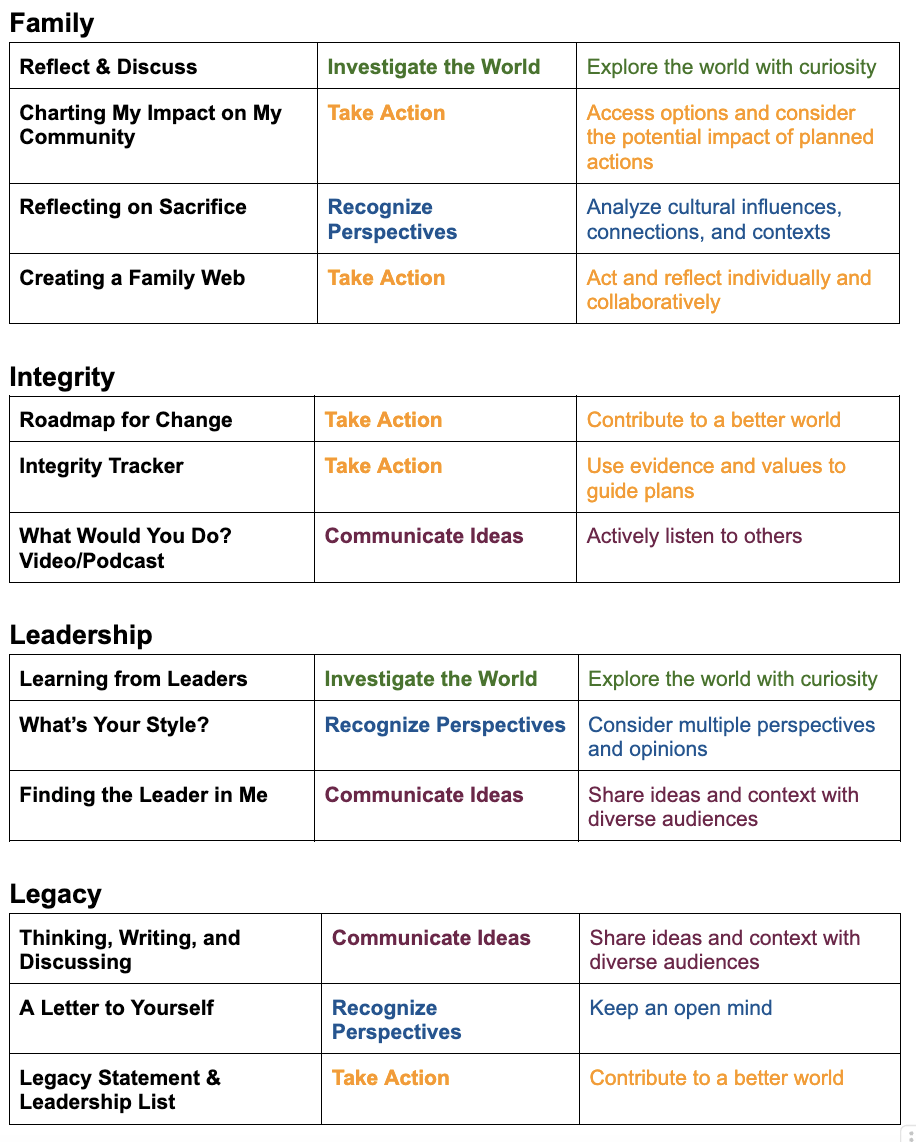
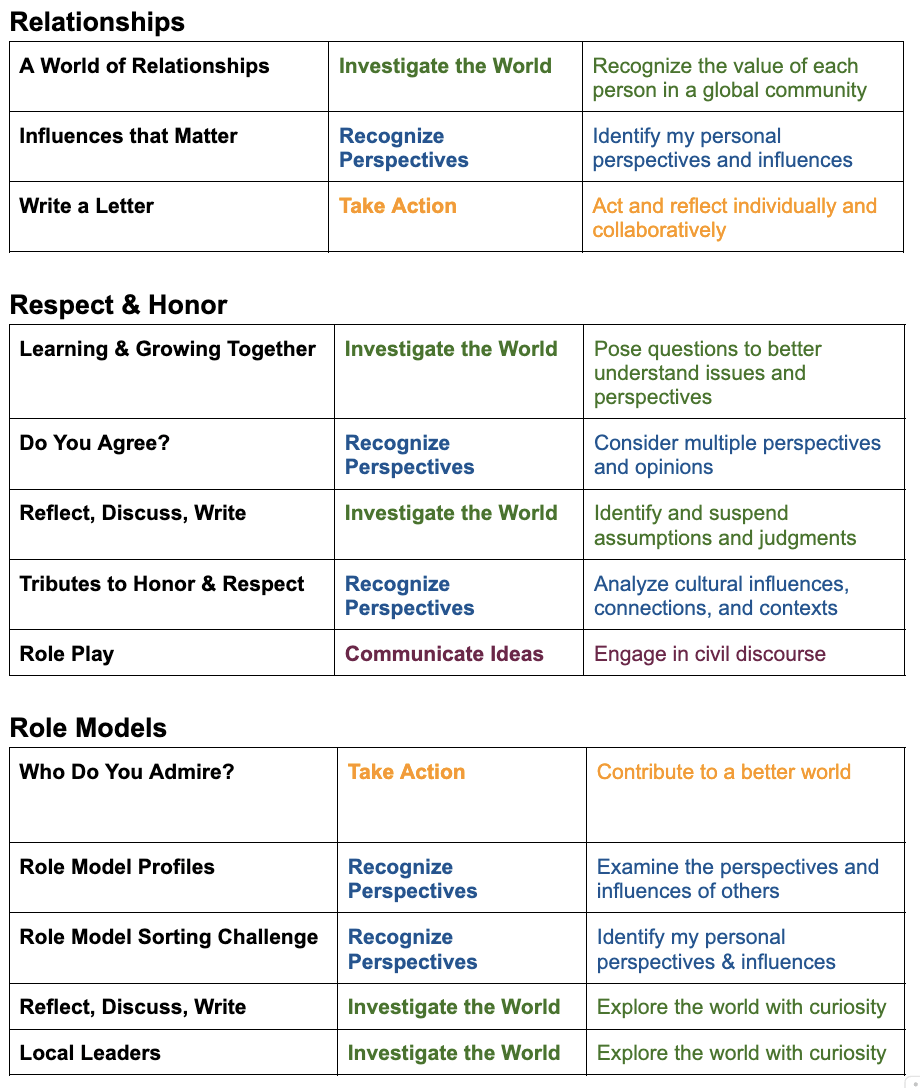
The themes and Learning and Leadership Activities in this guidebook are not intended to be used in any particular sequence or follow a particular timeframe. As the educator, select the theme that seems best for the youth you are working with at that time. Also, review and select the learning activities under that theme that best fit your goals, the group's needs, and your context. You can present these themes in the order that meets your needs, and you can also determine the pace of these learning activities. In other words, we built flexibility and choice into this guidebook so you can decide what to do, when to do it, and how long you want to spend on the learning. We created a chart to help you make those decisions, so you can see which Learning and Leadership Activities align with which domain and practice for global competence.

What is Global Competence?
Education leaders worldwide are working to help youth develop global competence, defined as the knowledge, skills, and disposition to understand and act on issues of global significance. The Organisation for Economic Co-operation and Development (OECD) created a similar definition while developing the Programme for International Student Assessment (PISA) 2018 assessment on Global Competence:
The capacity to examine local, global, and intercultural issues, to understand and appreciate the perspectives and worldviews of others, to engage in open, appropriate, and effective interactions with people from different cultures, and to act for collective well-being and sustainable development. (OECD, PISA)
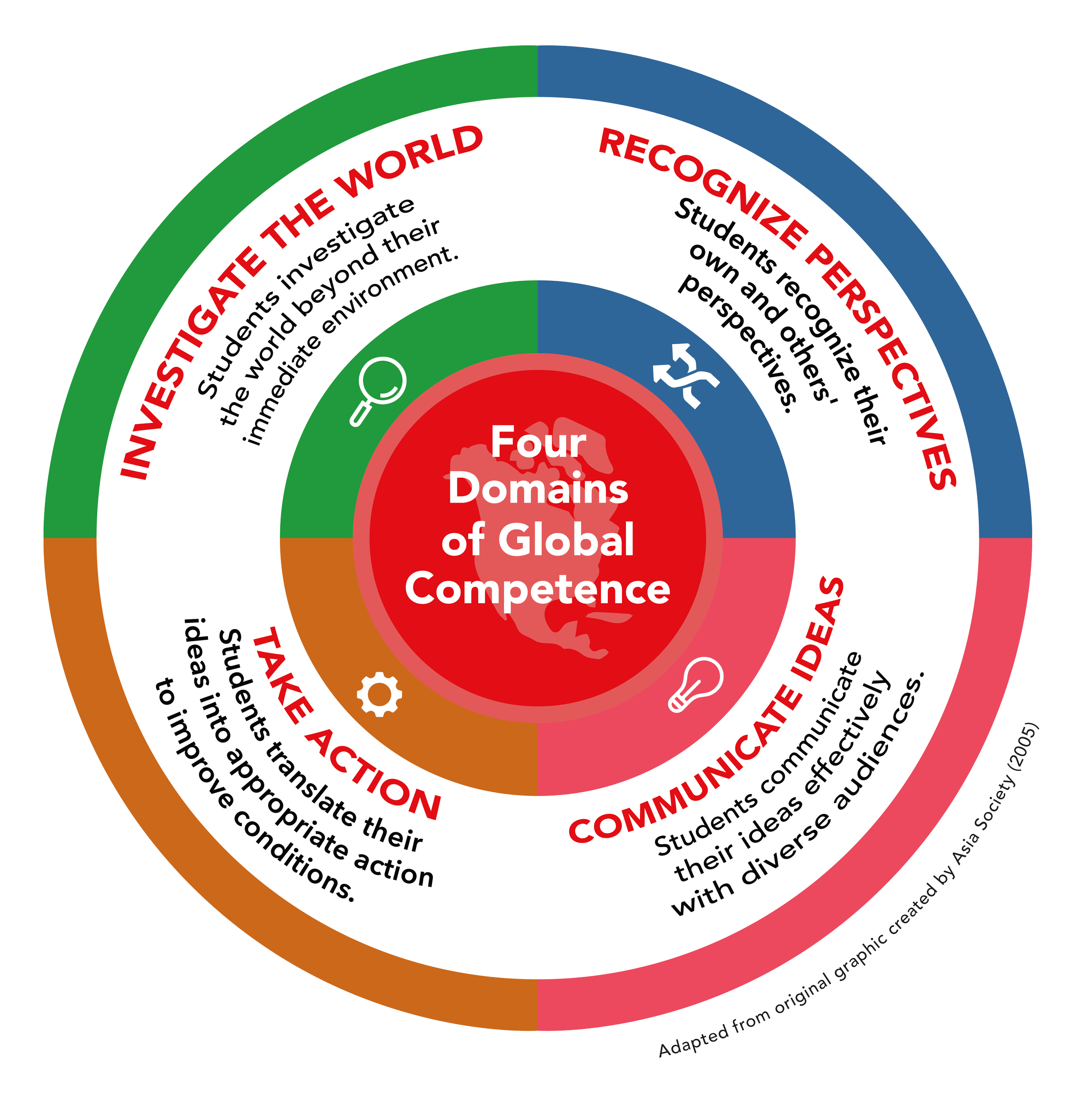
These four color-coded aspects of global competence align with the four domains of global competence, which are commonly used in education programs across the U.S. and abroad. The domains are:
Investigate the World
Students explore the world within and beyond their immediate environment while framing significant issues and conducting well-crafted, age-appropriate, inquiry-based research.
Recognize Perspectives
Students recognize others’ perspectives as well as their own. They articulate and explain such perspectives thoughtfully and respectfully.
Communicate Ideas
Students communicate ideas effectively with diverse audiences while bridging geographic, linguistic, ideological, and cultural barriers.
Take Action
Students translate their ideas into appropriate actions to improve conditions, viewing themselves as important contributors in the world who reflect, participate, and lead.
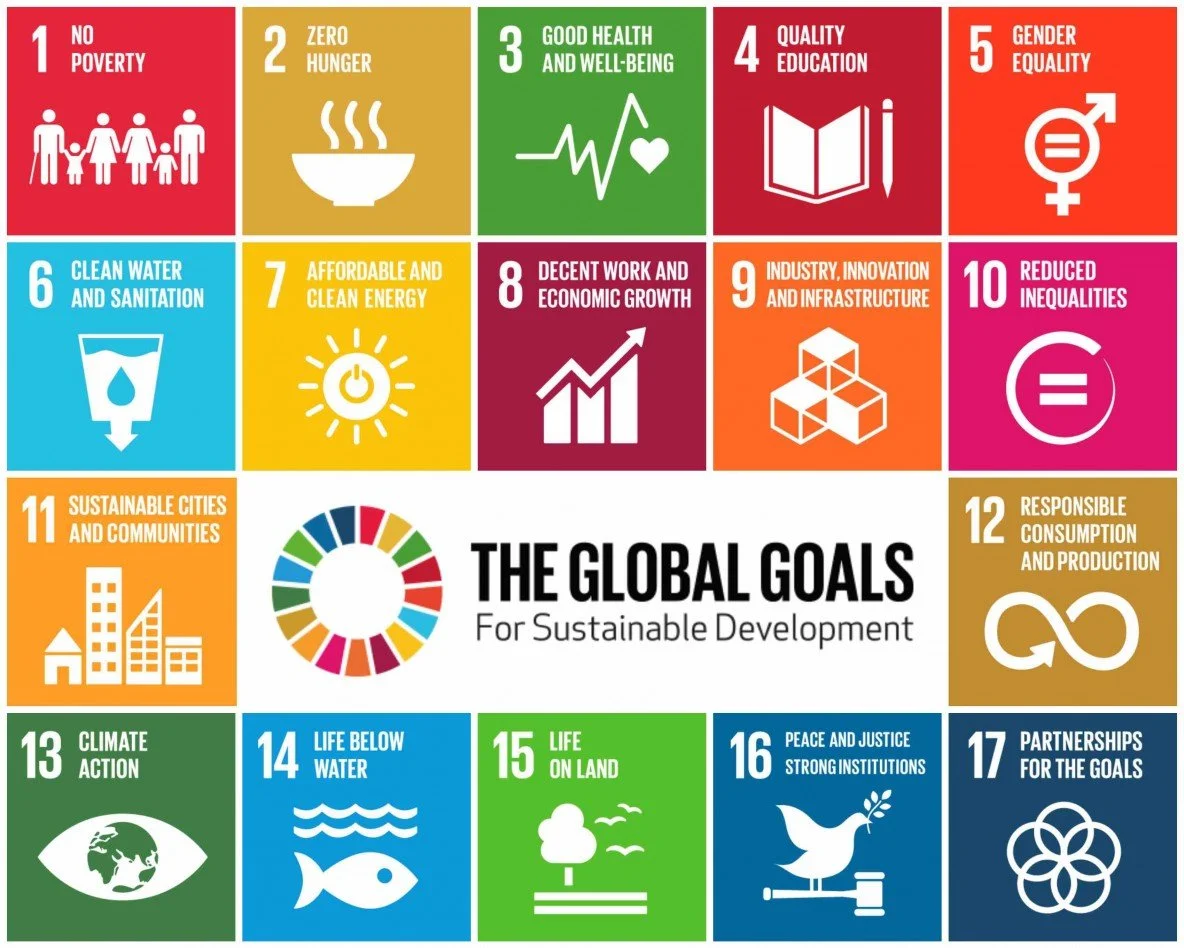
Throughout this guidebook, you will see learning activities that address these four domains, which are interrelated, complex, and always aligned with a global issue. The Sustainable Development Goals, or Global Goals, clearly describe global issues presented by the United Nations. However, local communities also face global issues, including inequities, economic and workforce development, climate change, poverty, healthcare, and other local-while-global, or “glocal,” issues.
These learning activities give you and participating youth space to connect stories, themes, challenges, and actions from the life of Arthur Ashe to your local and personal context. In other words, we wrote this guidebook to be as flexible and adaptive as possible so it achieves the overarching goals of global citizenship, civic engagement, and leadership in today’s youth.