Leadership
What does it mean to be a leader? What are the qualities of a strong and effective leader? These are the types of questions we must ask and answer while looking for and developing leadership. While there are many different types of leadership, a common goal for leadership is to guide and influence others. How leaders do that depends on their position as a leader and their philosophy of leadership. For example, an authoritarian leader makes all the decisions and dictates orders to others with little or no input from them. Democratic leadership is collaborative, values diverse perspectives and open communication, and involves team members in decision-making.
Arthur Ashe was a different kind of leader. He looked up to leaders who were upstanders for social justice and change, like Nelson Mandela and Muhammad Ali. While Muhammad Ali was outspoken and defiant, Nelson Mandela was visionary and resolute in his anti-apartheid activism. Today, Arthur might be recognized as a transformational leader – one who inspires and motivates others to achieve personal growth and contribute to a shared vision. A transformative leader is a mentor who empathizes with others, one who is seen as a role model, and a person who embraces inclusion. Arthur’s leadership can be seen in many examples of how he conducted himself throughout his lifetime. In one instance, Arthur received a letter from the tennis coach of 10-year-old Otis Smith who was receiving lessons at the Los Angeles Tennis Club. There had been complaints from club members that Otis was not a member and should not be playing on the courts. In effort to make Otis a junior member of the club, his tennis coach reached out to Arthur, who was an honorary board member, for support. Arthur wrote a letter to the LA Tennis Club Board of Directors that he would give up his seat on their board if Otis was not accepted as a junior member at the club. Otis received his membership due to Arthur’s quiet, yet forceful leadership in standing up to the Board of Directors. This happened in 1975 and Arthur used his influence as a well respected member of the tennis community to support the inclusion of a young, Black tennis player. (Interview with Otis Smith, 2020)
As a leader, Arthur wanted to continually support the changes needed in the sport of tennis and in the world. He demonstrated on the court that a Black man was capable of winning the highest honors in the world of tennis. Off the court, he demonstrated that change was needed to recognize, include, and respect all members of society. Sports journalist for the New York Times Neil Amdur spoke about Arthur’s on- and off-court leadership when he identified Arthur’s victory at the 1968 U.S. Open as monumental. “Arthur’s victory made him stand out not only because as an African American, what that represented, but also because he was a spokesman for the game and I think it represented to the game the fact that things are changing and the game better grow with it because Arthur is the kind of person who will take that level and it goes from sports page to the front page, if goes from from magazine to television. You look at certain seminal events and those events are the things that make history respect the quality of life that somebody like Arthur brought to his performance both on and off the court.” (Interview with Neil Amdur, 2022)

Learning and Leadership Activities
Learning from Leaders
Who are the leaders that appeal to you? What makes them appealing leaders? What have these leaders done? What can you learn from these leaders?
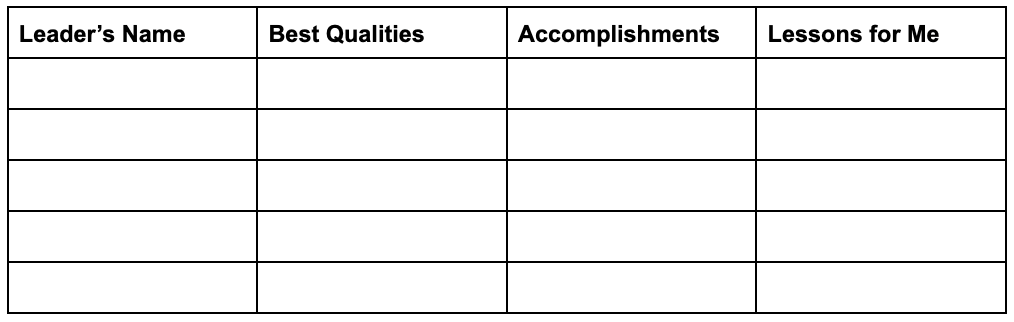
Make a chart like the one below in your notebook or journal. In the first column, write the names of leaders you admire or look up to. These can be people you know personally, local or national officials, and people you have read about or studied in school. In the second column, list the characteristics that help them shine as leaders. For example, they might be creative, well spoken, clear and direct, charismatic, or intelligent. In the third column, list some of the achievement of this leader. Finally, in the fourth column, list the things that you are learning from this person, which you might like to incorporate into your own leadership style.
When you are done with the chart, share with others and discuss the ways that you would like to grow as a leader.
What’s Your Style?
There are many styles of leadership, including:
Transformational Leadership: One who focuses on change, people, and the future. This leader inspires and motivates people to reach their potential while collaborating with others.
Delegative Leadership: One who trusts and relies on people to do their jobs. This leader delegates work to others and is “hands-off” while people work.
Authoritative Leadership: One who sets a course and encourages others to follow. This leader has a strong vision and mentors those around to join in this vision.
Transactional Leadership: One who establishes roles and responsibilities for others and believes in structure. This leader rewards those who get work done and applies consequences to those who do not.
Participative Leadership: One who believes in sharing decision-making and power with others on the team. This leader is inclusive and listens to others.
Servant Leadership: One who puts others’ needs first and creates strong relationships. This leader fosters loyalty and trust within the group so they feel safe being creative problem-solvers.
Did you know there were so many different ways to be a leader? There are more leadership styles than these six, and maybe there is one that you have developed and named for yourself. Which of these leadership styles sounds most like the kind of leader you are and/or want to be? Research one or more of these and write a description of the kind of leader that you want to be. Share your description with a partner and listen to your partner’s description. Discuss what you learned with each other.
Finding the Leader in Me
Below are the names of leaders and one of their quotes that help us learn more about their ideas as leaders. Read the quotes, select the ones you like and share them with others telling why you are interested in these quotes (i.e., you are inspired, you never thought in that way, you think the same way, etc.).
Kenneth Blanchard: The key to successful leadership today is influence, not authority.
Rosalynn Carter: A leader takes people where they want to go. A great leader takes people where they don’t necessarily want to go, but ought to be.
Winston Churchill: Success is walking from failure to failure with no loss of enthusiasm.
Walt Disney: All our dreams can come true if we have the courage to pursue them.
Mahatma Gandhi: The human voice can never reach the distance that is covered by the still, small voice of conscience.
Antonio Guterres: It is time to reconstruct relations between people and leaders — national and international. Time for leaders to listen and show that they care, about their own people and about the global stability and solidarity on which we all depend.
Jesse Jackson: Leadership cannot just go along to get along. Leadership must meet the moral challenge of the day.
Nelson Mandela: It is better to lead from behind and to put others in front, especially when you celebrate victory when nice things occur. You take the front line when there is danger. Then people will appreciate your leadership.
Lao Tzu: A leader is best when people barely know he exists, when his work is done, his aim fulfilled, they will say: we did it ourselves.
Malala Yousafzai: When the whole world is silent, even one voice becomes powerful.
Now write your own quote about living life as a leader. Share your quote with others and collect new quotes from them to add to your notebook or journal.