Family
What does it mean to be a part of a family? Can you choose your family? Someone once said, “Family isn’t always who you were born into, it is who stands beside you.” Arthur Ashe had a very clear idea about what it meant to be part of a family. Many people, both blood related and from the community in which Arthur grew up, helped to shape his behavior and values and he considered them all family. Probably the biggest influence in Arthur’s life was his father, Arthur Sr. Upon the death of Arthur's mother when he was just 7 years old, Arthur Sr. became both a parent and a mentor to Arthur and his brother Johnnie. He taught them about the weight of their family’s reputation in the community. It was through his father that Arthur learned to treat people with respect and kindness and to always walk in integrity and grace.
Another person who impacted Arthur’s life and his values related to family was his brother Johnnie. In 1965, Johnnie left high school to join the U.S. Marines – a branch of the U.S. military. He felt it was his duty and responsibility to serve his country. By this time, Arthur was experiencing great success at UCLA as a college tennis star. During his first tour of Vietnam in 1967, Johnnie knew that Arthur would soon be drafted into the military around the time that his own tour ended. Rather than let his older brother, who was breaking racial barriers in tennis, risk being sent to war, Johnnie volunteered for a second tour of duty, ensuring that Arthur would not be drafted while Johnnie was serving overseas. Johnnie said later, “I just didn’t think Arthur should have to go. He had much more to give through his tennis.” (Johnnie Ashe, in PBS American Experience: Arthur Ashe, 2018). Johnnie was reflecting the family values that he shared with Arthur – loyalty, sacrifice, and responsibility for others.
Near the end of his life, Arthur wrote a letter to his daughter, Camera, that expresses his deep sense of family, love, and legacy. It also communicated Arthur’s belief that family is both a moral foundation and a source of strength. “Camera, I will always be with you, always. You are the best thing that ever happened to me. You gave me something I had never had before – unconditional love… Remember that family is not just blood. It is the circle of people who love you, support you, and help you become who you are meant to be. Treat that family well, and you will never be alone in this world.” (Arthur Ashe, Days of Grace: A memoir, New York: Knopf, 1993, p. 317-18).

Learning and Leadership Activities
Reflect and Discuss
To Arthur and his family, their reputation in the community meant everything. Read the following quote from Arthur Ashe. Reflect on its meaning and have a discussion with a partner or small group using the questions that follow.
“A family’s good name – its reputation – is built through honesty, integrity, and service.” (paraphrased from Arthur’s reflections on his father in Days of Grace, Ch. 2)
What does it mean to have a “good name?”
How is a family’s reputation connected to how they are treated in the community?
What would you be willing to do or sacrifice for your family’s reputation and why?
Think about the reputation you have today. Are you pleased with it? Would the reputation you have today be an asset or a hindrance to you finding meaningful employment? What steps can you take to ensure that your reputation is something others in the community/workplace would want to embrace?
Charting My Impact on My Community
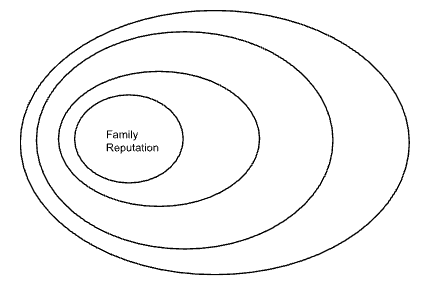
Draw a ripple map similar to the one below.
Add examples in the ripples that strengthen or damage a family’s reputation (e.g., kindness, reliability, dishonesty, compassion, etc.).
Which actions create the biggest positive “ripples” in a community?
What can you do to commit to those actions?
Who can you partner with so that your “ripples” can have even greater impact?
Share your ripple map and responses with a partner or small group.
Reflecting on Sacrifice
Johnnie’s act of sacrifice when he volunteered for a second tour in Vietnam taught Arthur that love within a family means doing what’s right for others. On a small Post-it note, 3 x 5 index card, or small sheet of paper, write about a time someone made a small or large sacrifice for you (without naming names). OR, think of someone you know from today or the past who made a difference in their community/nation/world by making a personal sacrifice. Next, place those reflections on a wall, a large table, or the floor, and walk around the area, reading the different posts.
What are you noticing about the different kinds of actions people took in the service of others?
What resonates most with you and why?
Do you think the people who made personal sacrifices for others felt they needed to be repaid or rewarded in some way? Why or why not?
What kinds of sacrifices are you willing to make for the greater good of your family, community, nation, and/or world?
Creating a Family Web
In Arthur Ashe’s letter to Camera, he reminded her, “Camera, I will always be with you, always.” On a sheet of paper, draw a picture or symbol of yourself at the center of a web. Around you, create shapes (circles, triangles, squares, etc.) that hold the names or roles of people who make up your “family.” (These could be blood relations but also might be friends, mentors, teachers, coaches, neighbors, pets). Draw lines connecting these members of your family, and on each line write a word or short phrase that illustrates how they show love, compassion, and/or support for you and each other.
Share one person on your web who isn’t related by blood but feels like family. How did they earn that place in your web?
What is one skill that someone in your family web demonstrates that you would like to develop and why? What steps can you take to develop this skill?
How does this broader idea of family connect to Arthur Ashe’s legacy of community leadership and engagement?
What is one way you can strengthen your ‘family’ at home, school, or in your community this week?
How can families build positive, productive relationships that lead to the betterment of all in the community?
Thinking about the broader idea of what makes a family, what role might you play in applying this idea to develop a more cooperative and collaborative workplace?
What is one skill that someone in your family web demonstrates that you would like to develop and why? What steps can you take to develop this skill?